Occupational Therapy for Hypermobility in Camp Hill, PA
What We Help With
Joint hypermobility occurs when joints have a greater range of motion than would typically be expected. Sometimes this does not cause any pain or symptoms, but in many cases it does cause joint instability, increased risk of injury, pain, and other symptoms. There may be a diagnosis of Hypermobility Spectrum Disorder, Hypermobile Ehlers-Danlos Syndrome, a different condition, or a diagnostic evaluation may not have been completed yet. In any case, we understand the unique challenges that may come with symptomatic generalized joint hypermobility.
We also understand that these challenges are often complicated by other co-occurring conditions, including postural orthostatic tachycardia syndrome (POTS) and other dysautonomia, mast cell activation syndrome (MCAS), functional neurological disorder (FND), persistent postural-perceptual dizziness (PPPD), complex regional pain syndrome (CRPS), fibromyalgia, ME/CFS, small fiber neuropathy, and GI dysmotility. We treat the whole, connected picture, not one diagnosis at a time.
We offer specialized occupational therapy services to children and adults experiencing symptomatic joint hypermobility.
If living with your chronic condition is also impacting your mental health, find more about our new specialized counseling department here.
(Why the Zebra? People with Ehlers-Danlos Syndromes or Hypermobility Spectrum Disorders often identify themselves as zebras. More details here.)
Our Approach: MOSAIC Neurofunctional Rehabilitation
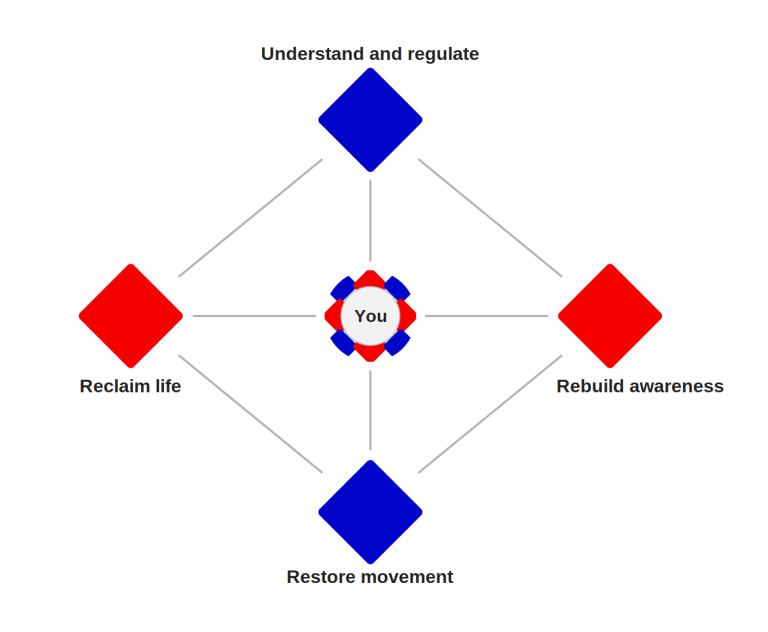
No two clients in this population look the same. Hypermobility, dysautonomia, mast cell activity, pain, and fatigue interact differently in every person, and treatment has to reflect that. We call our approach MOSAIC because your care is built the same way a mosaic is: many individual pieces, combined into one picture.
Treatment moves between four connected pieces, in whatever order and combination fits where you are right now, not in a fixed sequence:
- Understand and regulate. Learning how your nervous system produces pain and fatigue, and building tools to calm an overloaded system before adding physical demand.
- Rebuild awareness. Restoring your body’s sense of position, movement, and internal signals, which is often unreliable in hypermobility.
- Restore movement. Building active joint stability and functional strength in a way that’s safe for unstable joints and a compromised autonomic system.
- Reclaim life. Applying everything to the activities, roles, and routines that actually matter to you, sustainably, without triggering a crash.
These four pieces aren’t steps you complete and move past. We return to each of them throughout your care, based on what your system needs that week.
MOSAIC was developed at TCS by Andrea Gibson, MS, OTR/L, drawing on current pain science, autonomic regulation research, and years of direct clinical work with this population.
How MOSAIC Supports Chronic Pain, Fatigue, and Hypermobility
Understand and regulate
- Increasing knowledge and understanding of pain neuroscience and its interplay with hypermobility
- Increasing nervous system regulation to support symptom management
Rebuild awareness
- Increasing interoceptive awareness for better understanding of your physical and emotional needs
- Improving proprioceptive awareness to help your brain better understand where your body is in space
Restore movement
- Individualized physical rehabilitation support, including guidance through the ADaPT or CHOP protocols for POTS rehabilitation
- Specialized, targeted stability training to improve body mechanics, decrease pain, and decrease risk of injury
Reclaim life
- Designing environmental accommodations to make daily tasks more accessible
- Activity modification to support fluctuating symptoms
- Designing executive functioning supports to assist you in achieving day-to-day tasks, even when dealing with brain fog and low motivation
- Improving life balance to support your identity outside of your diagnoses
And throughout all of it: managing these pieces while also navigating neurodivergence, which is common in the hypermobile population.
Affirming, Trauma-Informed Care for Adults and Youth
- – We understand, because some of our providers live with these conditions too.
- – We have invested in additional education from experts leading the field, including EDS ECHO through the Ehlers-Danlos Society, Dysautonomia International, and more.
- – We have extensive experience working with neurodivergent children and adults utilizing an affirming, strength-based approach that we carry into our work with hypermobility.
- – Our approach is holistic, and takes into consideration not only your physical symptoms, but also emotional and environmental factors to ensure that all barriers to participation are addressed. We collaborate with you to identify priorities, then provide solutions to help you get back to the things you want and need to do!
What to Expect
Appointments are available either in-person or by telehealth to those living in Pennsylvania.
Evaluation
If you are having difficulty participating in any aspect of your daily life due to your hypermobility, we recommend scheduling an occupational therapy evaluation. No official diagnosis is needed. At your evaluation, we will speak with you to explore your concerns and challenges. We welcome your questions. We will listen. Please note that OT evaluations are NOT diagnostic evaluations, and are utilized only to identify functional challenges so that we may design your treatment plan if indicated.
Treatment
Research has shown that purposeful activity is the most effective and functional way to learn skills. We carefully design each session’s activities to target your goals in engaging, interesting ways. This will look different for each and every client. You will always have input into your sessions’ activities and goals, and will be given strategies to apply at home. You will also have 24-hour, secure access to your treatment notes, reports, and any other documents through your online client portal.
Achievement
Treatment plans will have a start and end date based on goals. Your therapist will frequently collaborate you to check in on your goals and progress. Therapy will end when you have achieved your goals, whatever that may look like for you. You are always welcome to return in the future if you have additional concerns or would like to explore additional strategies.
Payment
Detailed information for all clients is available on our insurance and payment page.